23 February 2014

MEET THE GARDENERS: JENNY CORR

IN THE HEART OF THE GARDEN

Walking into Jenny Corr's garden is to enter a gardener's paradise.  The old stone building, built as a hotel in the gold rush days of the 1860's, hides an extensive garden.   Huge old trees overhang the rambling paths and a riot of colour cascades across the perennial beds.

Jenny is a born gardener.  She has a sense of what to do and where to put things; a science and an art that is reflected in her garden.

Her grandparents had a grand garden near Colac in the Western District and Jenny can remember the joys of running across the lawns.  Her parents had a property near Chatsworth with a large garden and lawn tennis court.

As a child, Jenny's part of this garden was a veggie patch where she grew rhubarb  "and the odd carrot".


As a young mother with two small boys, Jenny moved to Wheatsheaf where she discovered the joys of the central highlands.

She bought the old hotel in Glenlyon, which was in a sad state of disrepair.  Converted into a house many years ago, it was unliveable, with tiny rooms, wobbly walls and rising damp.  The 'bathroom' consisted of an old chip heater and a tin bath.

The 'garden' had two enormous radiata pines, a couple of very diseased old apple trees, a huge hedge, one wisteria and an old disused well.  Jenny gradually cleaned up the house and garden while caring for her four young children, a very difficult juggling act.  She remembers that "When I had little children I was always in demand".  However, some days she would escape, leaving her partner in charge of the brood.  Her favourite place of refuge in the garden was "up the back".  To start the garden, Jenny pulled out the hedge and cut down the diseased trees.  She laid down black plastic, held down with bricks, and left it for six months.  Then she dug up the area and the beginnings of this beautiful garden were underway.  "It just sort of grew, this garden".


Jenny working 'up the back'

The unsightly hedges were replaced by fences to protect the large number of trees that were planted- oaks, lindens, parotias and ginkos, to name a few.

The garden grew and grew.  "I hate cutting grass" Jenny explains, so more and more of the lawns disappeared, to be replaced by garden beds.  Winding paths connect older parts of the garden to the newer areas, from shade to light.


A path to 'up the back'


Trips to the great gardens of Europe inspired the planting of heritage roses- bourbons, albas, gallicas, mosses and "tea roses but NOT hybrid teas!"

Jenny accessed plants from renowned nurserymen Dennis Norgate, David Glenn of Lamley and Jack and Zena Marshall of Frogmore, who also gave her invaluable advice.  The results can be seen in the creative selection of plants and the combination of colours in the perennial borders.

Riotous colour in a perennial border


However, following the prolonged drought and an awareness that her body is not getting any younger, Jenny is considering changes to the garden.

The seed of an idea is germinating, inspired by the 'wildness' achieved in English and European meadow gardens, where bluebells and other wildflowers grow amongst the native grasses, under spreading trees.  In Bhutan she was particularly impressed when she saw masses of irises growing wild.

"I would love to let the garden grow completely wild" explains Jenny "but it gets so out of hand!"  Nevertheless, bits of wildness are creeping into the garden, particularly 'up the back', where a copse of hazelnuts grow, brought to life in the Spring with a sea of bluebells.

Jenny's partner Peter's contribution to the garden adds a touch of whimsy.  He is a sculptor and the gates and other works of art dotted through the garden bring another visual dimension to this delightful place.  


The garden will evolve, as gardens do, with time and the increasingly inclement climate.  But Jenny's passion for gardens will expertly guide these changes to preserve the best and most endurable parts of this garden.


15 February 2014

MEET THE GARDENERS: MARGRET LOCKWOOD AT VIZSLA LAK

THE JOYS OF INDEPENDENCE


Marget Lockwood is an extraordinarily competent person.  From driving the CFA truck and chain sawing fallen trees, to writing, making jam and creating a beautiful garden- Margret takes it all in her stride.

She grew up in Braybook, in a family that was fiercely independent.  Her mother preserved fruit and vegetables from the garden to see them through the winter.   She also tended a flower garden.  Her father was a dab hand at woodwork, making shelves, tables and other essentials for the house.  Margret learned how to make the most of the resources at hand.  From an early age, she and her sister had household jobs to attend to; making beds, washing dishes and watering the garden.

Grandpa Davey was the vegetable gardener.  Grandpa was an intriguing character, with two fingers missing from his hands and a terrible cough - all as a result of working in the Wonthaggi mines. His veggie patch beside their house provided the family with vegetables.  Grandpa knew about the importance of mulch.  He would take a billy cart down to the flood plains of the Maribynong River and collect manure from the cows who grazed there.

A couple of uncles also helped to wet Margret's gardening appetite -  the taste of fresh carrots pulled straight from Uncle Steve's garden for example, and the snapdragon seeds given to her by another uncle, to grow in her own little flower garden.

It was the garden that first attracted Margret to her first house, set in the rolling hills of Gippsland.  The vestiges of a beautiful old fashioned garden could be seen beneath the mass of weeds.  She went to work with a vengeance, the family motto embedded in her mind - "The best way to keep cool is to keep working".

When Margret met and married Darryl, the love of her life, she discovered that although they shared a similar world view and many interests, gardening exposed some differences.  While Darryl liked hard edges and straight lines, Margret liked the softening influence of curves.

They bought a heavily treed block in Glenlyon and in 1996 built an environmentally sustainable house and a very large dam.  The dam, which sits in the garden like a beautiful lake, is essential for fire purposes.  But it is also the fulfilment of a dream.  While working in the deserts of Saudi Arabia, Margret says "I dreamed about the house that I would build and the garden that I would have - a green oasis".  She read everything that she could lay her hands on - books on permaculture, passive solar design and the inimitable Edna Walling.


The first job in planting a garden was to improve the very poor soils and they used newspaper, straw, manure and any other organic materials that were to hand.  Plants for the site were by and large those that Margret could grow from seeds or cuttings or plants that had been given to them.


Lemon tree and roses- gifts from family
Sadly, Margret is now on her own following Darryl's untimely death.  When Darryl knew that he was going to die, he helped Margret to learn to drive the tractor and carry out the many tasks for which he had taken responsibility.  It was a steep learning curve.  She studied the manuals for the equipment round the house and did a chain saw course.  In her mind were her father's words "Hard work's easy done - just get in and do it rather than think about it".  She is very inventive, making mulch with the hedge trimmer or running over branches with the slasher or the ride on mower.


Riding across Scotland- the last big ride with Darryl.


Margret at the Col du Samport border crossing while hiking across France, 2013


Despite the pain of loss, Margret has a sense of independence and being in control of her life.  She is able to make decisions without consultation, adding new touches to the garden, including wonderful sweeping curves that fit so well in this natural setting.


Being single following such a successful marriage has created deep personal challenges.  Margret reflects that following Darryl's death "I had to find out who I was again".  The garden has provided the solace that she required to search for meaning.  "Since I've been on my own I've put more time into gardening [because] there is peace in dirt.  I've found it very therapeutic".   Time in the garden clears her mind and allows her to reflect......

8 February 2014

MEET THE GARDENERS: Dee & Tony Briscomb at Doll's Paddock

GROWING INTO GARDENS GRACEFULLY

Dee and Tony grew up in Yorkshire, a world away from their current home in Glenlyon, in the central highlands of Victoria.  They have lived in many places, including the West Indies, and each place has influenced their views on gardens and gardening.

Dee exploring Musk Farm

As a small girl, Dee used to help her father in the garden.  Wielding a pair of scissors in her tiny hands, she would assist by cutting the grass away from the base of the apple tree.  She learned about growing plants by observing the seedlings that grew in her father's glass frame.  But the seedling frame holds some intriguing memories- the splintering of glass if she should fall, for instance.  Or the image of wriggling little maggots that grew out of the contraband ham, bought by her mother on the black market (these were the war years) and quickly buried when an inspector came visiting.

An important part of Dee's early education about gardens was provided through visits with her parents to some of the great English gardens.  For Tony, the war years and frequent moves by his family precluded any involvement with gardens or gardening.

In the early years of their marriage in England, Dee notes that they "were too sophisticated and urban to garden".  Their attempts at gardening involved "trying to tidy up the mess" of other people's gardens, as they moved from place to place.  The new house in York, for example, was "just a patch of mud", to which Dee added a beautiful clematis.  Or the house located in the grounds of H.G. Wells' property, with steep slopes of exposed clay and masses of roses, a challenge that was too confronting.  An exception was Hope Cottage, which, although very wild, was a wonderful garden, tied up in parts with the previous owners' lisle stockings.

Following a stay in Trinidad, where they were surrounded by the exotic and sweet-smelling plants of the tropics, Dee and Tony migrated to Sydney and then to a place in Melbourne.  This was their first opportunity to 'settle'.  However, they confronted the challenge of once more taking over a mess, but this time transforming it.  "When we moved in" said Tony, "there was a ten foot pile of rubbish, a red shed and a Mini Minor".

Melbourne was an entirely different place in which to garden, with its depleted soils, sudden weather changes, droughts and high winds.  With the assistance and advice of friends, one an architect and the other a landscape designer, Dee set about formally designing a garden.  Jan, her next door neighbour, provided her with invaluable advice about plants.

An existing apricot tree and a stand of bamboo formed the background to the evolving garden, to which was added formal brick paths and banks of flowering plants.  The wasteland became a lush haven, but eventually, for these world travellers, it was time to move on.  Following a brief time in Mirranatwa, they took over a horse paddock in Glenlyon.


The birth of a garden: Doll's Paddock


Following the building of their strawbale home, the development of the garden at Glenlyon required the transformation of a naked building site.  The house was 'floating' in the middle of bare earth, disconnected with the surrounding landscape of golden paddocks and the river valley beyond.  A low stone wall was erected to frame the house, the slope to the river was modified, and the outlet pipe down the slope provided the source of a notional waterfall.  Since then, masses of trees have been planted, including stands of crab apples and silver birches.   At the base of the rill, whispering allocasuarinas form an oasis.

Planning on the rill


Containing with a low wall


Listening to nature: drought tolerant plants


Dee has a great eye for colour, form, shape and perspective.  Drawing on her knowledge of the great English gardens, observation and endless conversations with informed friends (in particular Classics scholar and landscaper Ray Robinson), she and Tony have created a vibrant garden that sits comfortably in its rural Australian setting.  Importantly, they closely observe the cyclical nature of weather patterns and respond to the wordless messages that the plants provide, for as Dee explains, "nature itself tells you what is to happen".


31 January 2014

MEET THE GARDENERS: Linda Hamilton

LINDA HAMILTON: GROUNDING THE EXOTIC

Linda Hamilton has taken on a mammoth project.  Her farming property 'Lynbank' sits on top of a ridge overlooking the Loddon Valley.  The original owners of the farm, first established in the 1860's, planted a large European garden.  Huge old pines are a reminder of this first garden, planted around the house paddock to ward off the fierce south easterly winds.  Other tree survivors of this earlier age are the enormous walnuts, oaks, cedars, cypress and elms.  The original farmhouse was burnt down in a bushfire in the early 20th century, but these old trees survived.


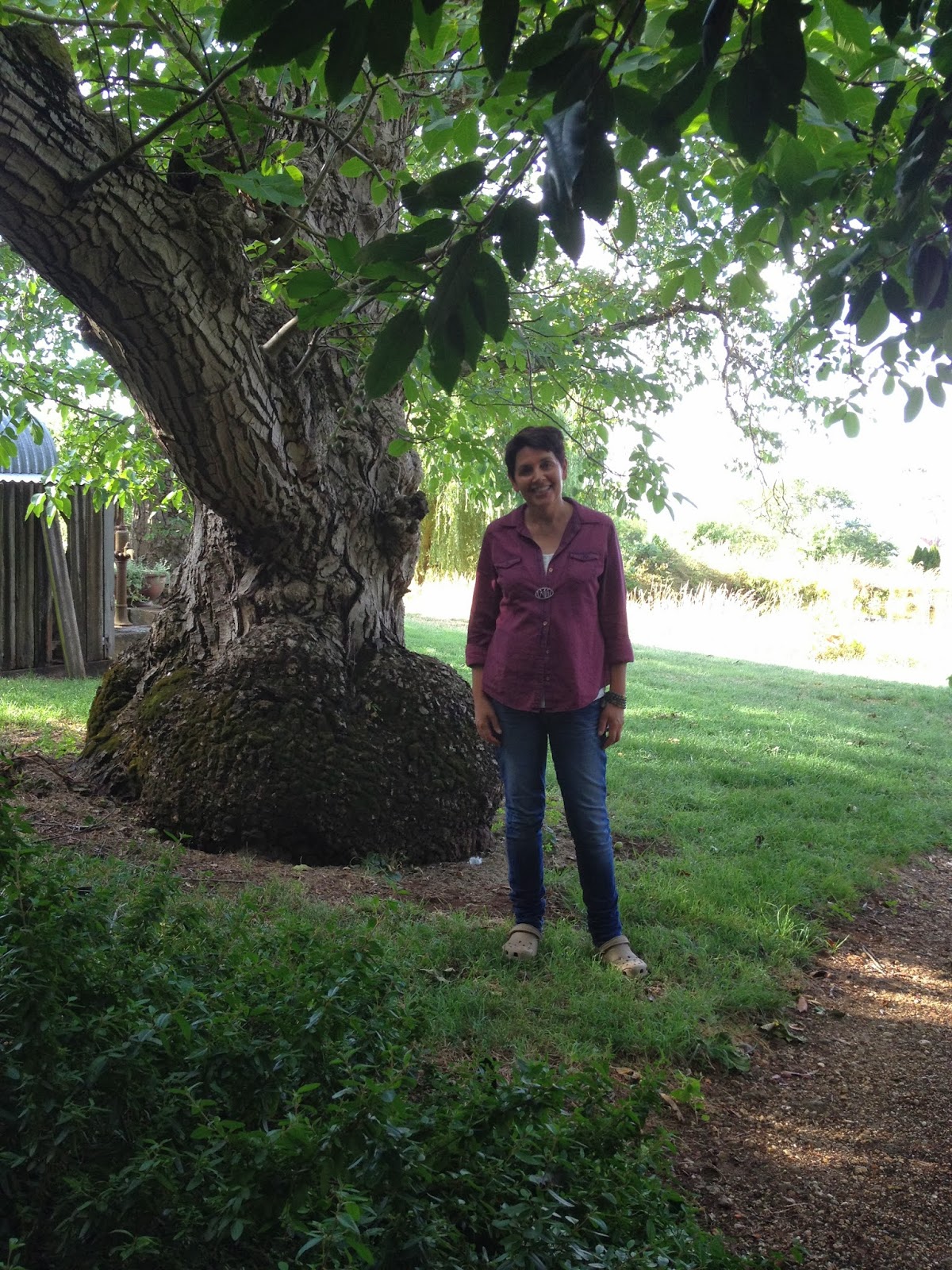
Linda beside a very old walnut tree


In the early 1990's, to take advantage of the magnificent views, a mediterranean villa was built on the highest but most exposed part of the property.  This imposing building with its blue wooden shutters, large patio and sweeping driveway made a strong statement on the surrounding Australian landscape.
The house was surrounded by an Italianate garden, a European style of highly floriferous but also heavily water dependent plants.  In formal European tradition, the beds of rhododendrons, azaleas, hydrangeas and annuals required constant watering from the dam, fed by an underground bore.

Hedges of buddleias and conifers added to the formality of the garden.

Three gardens in one: old pine trees c 1860's, fountain c 1990 softened by Linda's plantings.


Linda, quite new to gardening, knew that something was wrong- the house and garden didn't fit the landscape.  The garden needed 'opening out' to incorporate the broader and most beautiful views.
Facing this huge challenge, she undertook a course in garden design, studying Brookes, Pearson, Piet Oudolf and their Australian counterparts.

With this new knowledge and many conversations with gardening friends, Linda set out to transform the garden to meld with the Australian landscape, whilst maintaining the best features of previous gardens.  Firstly, she allowed some heavily water-dependent plants to die.  Those that survived were nurtured, along with the new plantings.  Next, she removed the buddleia hedges and some of the newer conifer plantings that obscured the broader views of the garden.  Now the beauty of the old oak tree trunks could be seen, along with glimpses of the blue hills beyond.

Opening up the landscape: An old pump and blue hills beyond
Archways and small paths create mystery


Linda has learned the joys of the bobcat.  Now straight lines are being transformed and curves are entering the landscape, reflecting the rolling hills beyond.  Removal of some mid storey plants has allowed for the development of archways over small pathways throughout the garden, adding a sense of mystery to a garden stroll.  Water dependent annuals and perrenials are gradually being replaced with swathes of poas, correas, scaevolas and other picturesque but drought hardy plants.  Stands of snow gums soften the more formal lines of their exotic counterparts.  An imposing formality has been replaced by a more intimate space.

Drought tolerant plants reduce water use


This gardening experience has been a major challenge for Linda. "I've really struggled with this garden; [with] its size and what it represented to me - materialism and Western affluence".  She learned to let go of some preconceived traditional concepts of garden design, of lines and neat edges.  She has developed 'a shared relationship' with the garden, respecting the natural ebbs and flows of its plants.  "The garden is my greatest teacher and I have discovered so much about who I am".

Central to the changes that Linda has made to her place is the the notion of sustainability.  Firstly, mindfulness of finite natural resources such as water.  Secondly the transformation of a garden which is alienated from its environment to a space that encourages local wildlife and welcomes human visitors.  And finally, as Linda explains "the garden is so big and overwhelming, it must be sustainable for me.   How can I work with the garden so that it sustains me?

There is a balancing act between changing things to reveal the spirit of the place [but at the same time] not making more work".


Linda gains immense pleasure from her garden.  She explains that a garden can " bring you really close and embrace you".  Nevertheless, there is still a great deal of work to be done.  Sustained by her family and friends, and with the help of the trusty bobcat, she is gradually transforming a beautiful but alienated garden into one that retains its beauty while fitting comfortably into its place.  It's a reciprocal relationship; Linda nurtures the garden and in turn, the garden nurtures her.


18 January 2014

Meet the gardeners

IN THE NEXT MONTH WE WILL BE FEATURING THE GARDENERS OF GLENLYON. 


You will read about their gardening aspirations, their joys and their sorrows and how they have transformed a patch of dirt into their very own piece of paradise.

17 January 2014

Festival at Lavandula

We are surrounded by beautiful gardens in Glenlyon and District; places that provide inspiration for gardeners like us.

Lavandula is one such place.  Originally an old dairy farm in the Swiss-Italian tradition, owner Carol White has transformed it into a beautiful lavender farm.  With a very keen artistic eye, Carol has used the framework of lovely old stone buildings to create magnificent gardens that flow from this hub.


Lavender is the key feature of the gardens, surrounded by magnificent trees.


The lawns came alive with Morris Dancers during the festival, to celebrate the harvesting of the lavender.


The lavender is distilled on the property to make lavender water and lavender oil in equipment that evokes memories of earlier times.


Lavandula presents a wealth of ideas in garden design, from the flowing gardens and walk ways to the beautiful stone walls and strategically placed 'objects d'art'.  

The placement of objects can be a hazard- what looks sensational in one garden setting may look like a piece of junk in another.  

5 January 2014

Critters in the garden


Every nook and cranny at Greenlion is inhabited by critters.  And being an unrushed, contemplative and bending down sort of activity, gardening is an ideal way to find out who lives where.  Take the dam for instance (above); it's teeming with aquatic life - tadpoles, boatmen, wrigglers and the like.


Some of the aquatic critters make tasty morsels for humans and water birds, especially the yabbies.


Careful observation is rewarded with the discovery of the more elusive little creatures, as well as providing solitude.


Echidnas try to be elusive by digging themselves into the ground to protect their vulnerable underbellies.   We have a metre high rabbit proof fence around the house block to deter visitors such as hares, rabbits, wallabies and deer.  One would think that the echidnas would be inadvertently barred from the garden too, but they can climb the fence by holding on with their fierce claws.


Quite recently we discovered a new resident- the little jackie lizard.  They are amazingly bold.  This one was skipping round my feet as I worked in a very dry part of the garden.

The skinks sun themselves on rocks but with any sign of movement they head for cover.


The blue wrens are the boldest of all the birds in the garden.  They literally catch insects and worms beside our feet as we work in the garden.


At Vizsla Lak, Margret has sign posted the driveway to warn visitors that there are ducks crossing.  Come Spring and there is a constant to-ing and fro-ing from the dam to the grasslands
jumping with insects.


Of course, although insects provide great tucker for birds, they may not appeal to humans.  This spider was in a rock pool on the river.  The children initially tend to respond to spiders with fear, but we teach them about the important role of spiders in the world and they learn to treat them with respect.


However, 'To live and let live' can try the patience of Jove.

We first noticed some holes in a secluded part of the garden.  They weren't rabbit holes and we were puzzled.  Then there were more holes, then more and more and we had a problem on our hands.  The place was starting to look like a scene from 'The Great Escape'.

We asked a friend who suggested that we had bush rats.  They had spread across the garden, digging underground tunnels all over the place.  Our patience was wearing thin.  They had dug their way dangerously close to the veggie patch.

Finally, after a visit to 'Its A Trap', we caught one of the culprits with a trap baited with fresh carrots.


And this is what we caught.  Isn't he or she beautiful?  After capturing and relocating 15 bush rats to a lovely place beside the river, and well downstream, we repaired the garden.

Hopefully our furry little friends are happy in their new bush setting.